
Unlike the mechanistic view that treats companies as profit-producing machines, the regenerative approach sees the organization as a living system. It has identity, life cycles, adaptation crises, and a role in the larger ecosystem. Regenerative Tarot acts here not as an oracle, but as a diagnostic lens, revealing hidden patterns (shadows) and latent potential (seeds) to guide decision-making.
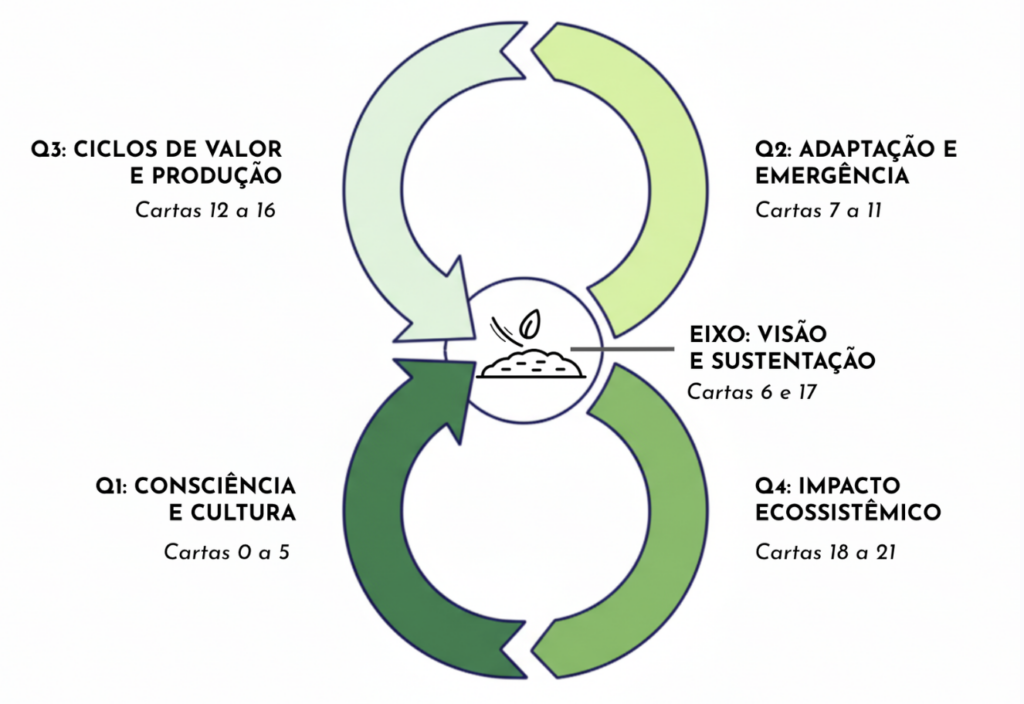
Q1: AWARENESS AND CULTURE (Cards 0 to 5)
Where it all begins.
Before taking action, the organization needs to look inward. This quadrant deals with deep identity, real purpose (not just marketing), and corporate "shadows" (what is said vs. what is done). It is the stage of recognizing the DNA and culture that will sustain growth.
Practical examples:
1. Culture and Shadow Audit: Map inconsistencies between stated and practiced values.
2. Definition of Evolutionary Purpose: Replace the static mission with a living intention that guides autonomy.
3. Memory Rescue Ritual: Honoring the founding story to unlock future innovation.
AXIS: VISION AND SUSTAINABILITY (Letters 6 and 17)
The Portal of Materialization.
It is the meeting point between intention (Seed) and feasibility (Soil). Here, the dream gains infrastructure. There is no point in having a regenerative vision without allocating time, money, and people to nurture it. It is time for strategic planning and designing feasibility.
Practical examples:
1. Innovation Budget: Allocate protected resources to risk/regeneration projects.
2. Bio-inspired Strategic Planning: Design goals inspired by nature's cycles (not just linear growth).
3. Support Capacity Assessment: Analyze whether the team has the health and tools to deliver on the vision.
Q2: ADAPTATION AND EMERGENCY (Cards 7 to 11)
The Reality Test.
The idea leaves the drawing board and encounters the world. This quadrant focuses on interaction with the ecosystem, forming alliances, and the ability to adapt (anticipation and pivoting). It is about surviving the dryness of the market through collaboration and agility, allowing the new to emerge.
Practical examples:
1. Coopetitive Alliances: Collaborate with competitors to solve systemic pain points in the industry or region.
2. Dynamic Governance (Sociocracy): Decisions by consent to streamline adaptation.
3. Rapid Prototyping: Test small ideas before scaling up, learning from mistakes.
Q3: VALUE AND PRODUCTION CYCLES (Letters 12 to 16)
The Metabolism of Business.
The operation, delivery, and outcome phase. Here we look at financial sustainability, operational efficiency, and, crucially, circularity. It involves knowing how to grow, make a profit, but also recycle.
waste and discard what is no longer useful.
Practical examples:
1. Circular Design (Cradle to Cradle): Designing products with their end of life in mind (no waste).
2. True Cost Pricing: Include social and environmental costs in the price.
3. Closing Rituals (Pruning): Formal processes for finalizing failed projects and recycling lessons learned.
Q4: ECOSYSTEM IMPACT (Cards 18 to 21)
The Legacy and Evolution.
The highest level of the spiral. The organization ceases to operate solely for itself and begins to regenerate the whole. It focuses on ESG, diversity as a source of strength, and positive net impact. It is the preparation to start a new cycle at a higher level of consciousness.
Practical examples:
1. Net Positive Goals: Give back to the environment more than is taken from it (water, carbon, biodiversity).
2. Responsible Ownership: Legal structures that protect the purpose of predatory sales.
3. Inclusive Innovation: Creating solutions with and for marginalized groups.